
Our 400 Series Ball Valves deliver the same reliable quarter-turn isolation as the rest of our ball valve range, engineered for applications operating at higher pressure classes or more demanding service conditions than the 300 Series is intended for. The core mechanism stays consistent across the family a precision-machined ball with a bored-through passage rotating between fully open and fully closed but the 400 Series is built with material selection, seat design, and construction tolerances suited to tougher operating environments.
As with every valve we manufacture, each unit is machined to tight tolerance, assembled carefully, and individually pressure-tested before it ever leaves our facility.
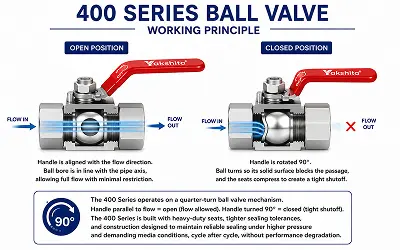
Mechanically, the 400 Series works the same way as any quarter-turn ball valve: a spherical ball with a through-bore sits between two seats, and rotating the handle 90 degrees moves the ball from a flow-aligned position to a fully blocked one, with the seats compressing against the ball to create a tight shutoff.
The distinction with the 400 Series lies in what's built around that core mechanism heavier-duty seat materials, tighter sealing tolerances, and construction suited to holding that seal reliably under higher pressure and more demanding media conditions, cycle after cycle, without the sealing performance degrading over time.
400 Series
Quarter-turn rotating ball with bored-through passage
Machined from higher-grade material suited to demanding process and instrumentation service
Individually pressure-tested before dispatch
Manufactured under ISO 9001:2015 certified processes
Exact pressure and temperature ratings for the 400 Series depend on the specific material grade and application our team can confirm figures against your project's operating conditions.
Stepping up to the 400 Series isn't about over-specifying for the sake of it it's about matching the valve to conditions the 300 Series genuinely isn't built for. We manufacture the 400 Series with that distinction taken seriously: higher-grade materials, tighter tolerance control on the ball-and-seat fit, and the same individual pressure testing we apply across our range, so the extra capability you're paying for is actually built into the valve rather than just implied by a higher series number.
If you're not sure whether your application genuinely needs the 400 Series or whether the 300 Series would suffice, that's exactly the kind of question our engineering team can help settle before you commit to an order it saves cost when a lighter series will do, and saves a failure when it won't.
Higher-grade materials, tighter sealing tolerances, and construction built to hold up under higher pressure and tougher media conditions.