
Our Manifold Valves are engineered to bring together multiple valve functions typically isolation, equalization, and venting into a single unit designed for direct connection to differential pressure instruments like transmitters. Instead of assembling a cluster of individual valves and connecting pipework around a transmitter, a manifold valve does the same job in one compact, factory-tested block, reducing both installation complexity and the number of potential leak paths in the system.
Every manifold valve we manufacture goes through the same rigorous process as the rest of our range precise machining, careful assembly, and individual pressure testing before dispatch.
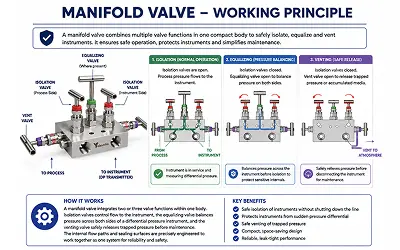
A manifold valve typically integrates two or three valve functions within one body. The isolation valves control flow from the process line to the connected instrument, allowing the transmitter to be safely isolated for maintenance or replacement without shutting down the entire line. The equalizing valve, where present, allows pressure to be balanced across both sides of a differential pressure instrument before it's isolated, protecting sensitive internals from a sudden pressure differential during start up or shut down.
A venting valve allows trapped pressure or accumulated media to be safely released from the instrument connection before it's disconnected for service. Combining these functions into a single precisely machined block means the internal flow paths and sealing surfaces are engineered to work together as one system, rather than depending on multiple separate valve connections lining up correctly.
Integrated multi-valve block (isolation, equalizing, venting functions)
Direct mounting to differential pressure transmitters and instruments
Machined from selected material grades suited to instrumentation service
Individually pressure-tested before dispatch
Manufactured under ISO 9001:2015 certified processes
Exact configuration 2-valve, 3-valve, or 5-valve manifold along with pressure and temperature ratings, is confirmed against your specific instrument and application requirement.
A manifold valve only delivers its space and reliability advantage if the internal machining is precise enough to keep every integrated function sealing correctly at once a single weak seat inside a multi-valve block undermines the whole unit. We manufacture ours with that in mind, applying the same tight tolerance control and individual testing standard across the entire block, not just the primary isolation function.
In case the configuration of your instrument manifolds is critical for compatibility with your transmitter model and process conditions, please feel free to verify this information with our engineers prior to placing your order.
Isolation, equalization, and venting functions, integrated into a single compact block for connection to differential pressure instruments.