
Our Safety Valves are manufactured to automatically relieve excess pressure from a system before it reaches a level that could damage equipment, compromise piping integrity, or create a genuine safety hazard. Unlike valves operated manually or through routine process control, a safety valve works independently it's set to a specific pressure threshold and opens on its own the moment that threshold is crossed, without needing anyone to notice a gauge reading and react in time.
Because these valves are effectively your last line of defense against overpressure, we manufacture them with a level of consistency that leaves no room for ambiguity precise set-pressure calibration, reliable spring-loaded mechanisms, and individual testing before dispatch.
The operation of the safety valve depends upon the basic yet critical mechanical concept of using the spring to keep the disc pressed tightly against the seat. When the pressure within the system rises to reach nearly the set pressure for the valve, then the force on the disc becomes more than that of the spring force. At that point, the disc lifts off the seat, and excess pressure vents through the valve until the system pressure drops back to a safe level, allowing the spring to reseat the disc and reseal the valve.
The reliability of this entire process comes down to two things: accurate calibration of the set pressure, and a clean, consistent reseat once the excess pressure has been relieved. A safety valve that pops open reliably but doesn't reseat properly just trades one problem for another continuous venting instead of overpressure.
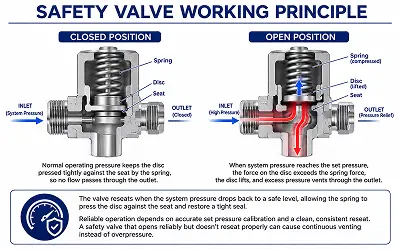
Spring-loaded disc and seat, automatic opening at calibrated set pressure
Machined from selected material grades suited to process and instrumentation service
Set pressure calibrated and verified before dispatch
Individually tested for accurate opening and clean reseating
Manufactured under ISO 9001:2015 certified processes
Set-pressure range and temperature ratings depend on the application and material grade our team can confirm exact specifications for your system.
There's no acceptable margin for error with a safety valve it either opens at the right pressure and reseats cleanly, or it doesn't do its job. We manufacture ours with that understanding built into every stage: accurate set-pressure calibration verified before dispatch, spring mechanisms selected for consistent long-term performance, and individual testing rather than batch sampling, because this isn't a component where "good enough on average" is an acceptable standard.
If your system has a specific set-pressure requirement or relief capacity you need to meet, that's exactly the detail our engineering team wants to confirm with you before your order is finalized not something to discover during commissioning.
Set pressure is calibrated based on your system's safe operating limits our team can help confirm the correct setting for your application.