
Our Pipe Fittings are manufactured to connect, adapt, and redirect process piping across instrumentation and utility lines — elbows, tees, couplings, adaptors, and similar configurations built to maintain sealing integrity under real operating pressure. Where a valve controls flow and a tube fitting connects tubing to a device, pipe fittings handle the structural job of joining pipe sections together correctly, at the right angle, size transition, or branch point your piping layout requires.
Every pipe fitting we manufacture is machined to precise tolerance and checked for dimensional accuracy and sealing performance before dispatch, because a poorly fitted joint doesn't just risk a leak — it puts unnecessary mechanical stress on the entire piping run around it.
Pipe fittings normally depend on either threading or socket connections for joining pipe sections. In case of threaded connections, there are similar threads that join between the pipe and the fittings, and in most cases, there is an application of a sealant or sealing tape to eliminate any leaks in the joints. Socket-type fittings, by contrast, accept the pipe end into a machined socket, typically secured through welding, to create a continuous, high-strength joint suited to higher-pressure or higher-stress applications.
Whichever connection type is specified, the fitting's job is to maintain both a leak-tight seal and the structural strength needed to handle the piping system's operating pressure, thermal expansion, and any mechanical loading from vibration or supported weight along the line.
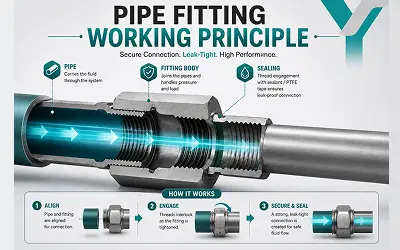
Threaded and socket-type, depending on application
Elbows, tees, couplings, adaptors, and related fitting types
Machined from selected material grades suited to process piping service
Checked for dimensional accuracy and sealing performance before dispatch
Manufactured under ISO 9001:2015 certified processes
Pipe size, connection type, and pressure rating are confirmed against your specific piping specification.
Pipe fittings are placed at stress points in your pipe network – be it bends in the piping to redirect the flow of fluid, couplings to join two different pipes – and accuracy at this joint is just as crucial as the rest of your piping. Our pipe fittings are fabricated with the same high tolerance control that goes into all of our products, thus ensuring that the joints in your piping network stand up to pressure and don't become the weakest link.
If your piping network requires a specific kind of fitting or a certain size transition, our engineers can verify compatibility prior to your purchase order.
Threaded fittings connect via matching threads, often with sealant, while socket-type fittings accept the pipe end into a machined socket, typically secured by welding for higher-strength joints.