
Our Tube Fittings are manufactured to create secure, leak-tight connections between tubing and instrumentation components valves, gauges, manifolds, and other devices across process and instrumentation lines. Unlike welded or permanently bonded connections, tube fittings offer a mechanical seal that can be assembled, disassembled, and reassembled during maintenance without compromising the connection's integrity, which matters a great deal in instrumentation systems that need periodic servicing.
Every tube fitting we manufacture is machined to tight tolerance and tested for sealing performance before dispatch, because a fitting that seeps even slightly under pressure can throw off sensitive instrumentation readings or, worse, lead to a larger failure over time.
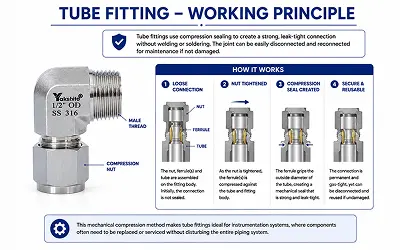
A tube fitting usually operates on a principle of compression sealing – where the ferrule(s) is compressed around the outside diameter of the tube as the nut of the fitting is tightened, making a mechanical seal without the need for welding or soldering the tube joint. As the nut tightens on the fitting body, the ferrule engages with the outside diameter of the tube sufficiently to make a seal that is permanent and gas-tight, but can be disconnected and rejoined later during maintenance of the tube if not damaged.
This mechanical method makes the use of tube fittings particularly feasible in instrumentation, since individual components frequently require replacement without having to redo the whole joint.
Compression-type, ferrule-based sealing on tubing
Machined from selected material grades suited to instrumentation and process service
Tested for leak-tight sealing performance before dispatch
Manufactured under ISO 9001:2015 certified processes
Tube size, thread type, and pressure rating are confirmed against your specific instrumentation and tubing specification.
A tube fitting's entire value depends on machining precision at the ferrule and body interface get that wrong, and you're looking at seepage under pressure or a connection that won't reseal properly after maintenance. We manufacture our tube fittings with the same tight tolerance control applied across our full product range, so the connections you're installing hold up the way your instrumentation system depends on, disconnection after reconnection.
If your project has a specific tube size, thread standard, or material requirement, our engineering team can confirm compatibility and specifications before you finalize your order.
Yes, provided the tubing itself isn't damaged, compression-type tube fittings can typically be disassembled and reassembled while maintaining a reliable seal.