
Our ball valves are manufactured for reliable, low-maintenance isolation duty across process and instrumentation lines. The design centers on a rotating ball with a bored-through passage turn it in line with the flow path and the valve is open; turn it 90 degrees and the passage seals against the body, cutting flow completely. We manufacture this range across three configurations to suit different pressure classes and installation needs: 300 Series, 400 Series, and Panel Mounting ball valves.
Each valve is machined and assembled to tight tolerances, then individually pressure-tested before it leaves our facility, because a ball valve that doesn't seal fully in the closed position defeats the entire reason it was installed.
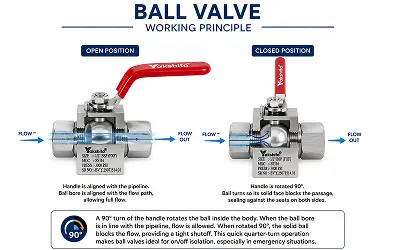
The design of this valve is mechanically straightforward, which is one of its advantages. The precisely machined ball is placed into the valve housing; it has a bore passing through the middle of the ball. Once the handle is aligned with the axis of the pipeline, the ball bore will be aligned with the media flow path. Rotate the handle 90 degrees, and the ball turns so its solid face blocks the passage, sealing against seats on either side.
That quarter-turn action is what makes ball valves so much faster to operate than a needle or gate valve when a line simply needs to be turned on or off useful in emergency isolation scenarios where every second of hesitation matters.
300 Series, 400 Series, Panel Mounting
Quarter-turn rotating ball with bored-through passage
Machined from selected material grades suited to instrumentation and process service
Individually pressure-tested before dispatch
Manufactured under ISO 9001:2015 certified processes
Pressure class and temperature ratings vary by series and material grade our team can confirm exact figures for your application.
The appeal of a ball valve is its simplicity, but simplicity only holds up if the machining tolerance behind it is tight enough to seal reliably, cycle after cycle. The 300 Series, 400 Series, and Panel Mount ball valves we produce are all produced with these factors in mind – traceable materials, exact ball and seat machining, and individual pressure testing. If you’re looking for high pressure class ball valves for pipe work, or smaller panel mounted valves for instrument racks, it’s the same quality standards that apply.
If you don’t know what series will match your pressure class and requirements, it might be worth discussing this with our engineers prior to placing your order.
The series primarily differ in pressure rating and construction specification our team can confirm which series matches your application's operating conditions.